
In October 2024, JM Fry Printing Inks came under new ownership, led by the father-and-son team of Jerry Mosley, Chairman of the Board, and Michael Mosley, President and CEO. Oak Street Printing LLC does business as JM Fry Printing Inks, continuing a long and rich history in the corrugated market.
The other C-suite partners include John Gaber, Chief Commercial Officer; Rachel Wooten, Chief Financial Officer; Scott Mosley, Chief Technology Officer; and Darrell Kelly, Chief Information Officer. Gaber has a long history with the Mosleys, stretching back to their time working together at Flint Ink.
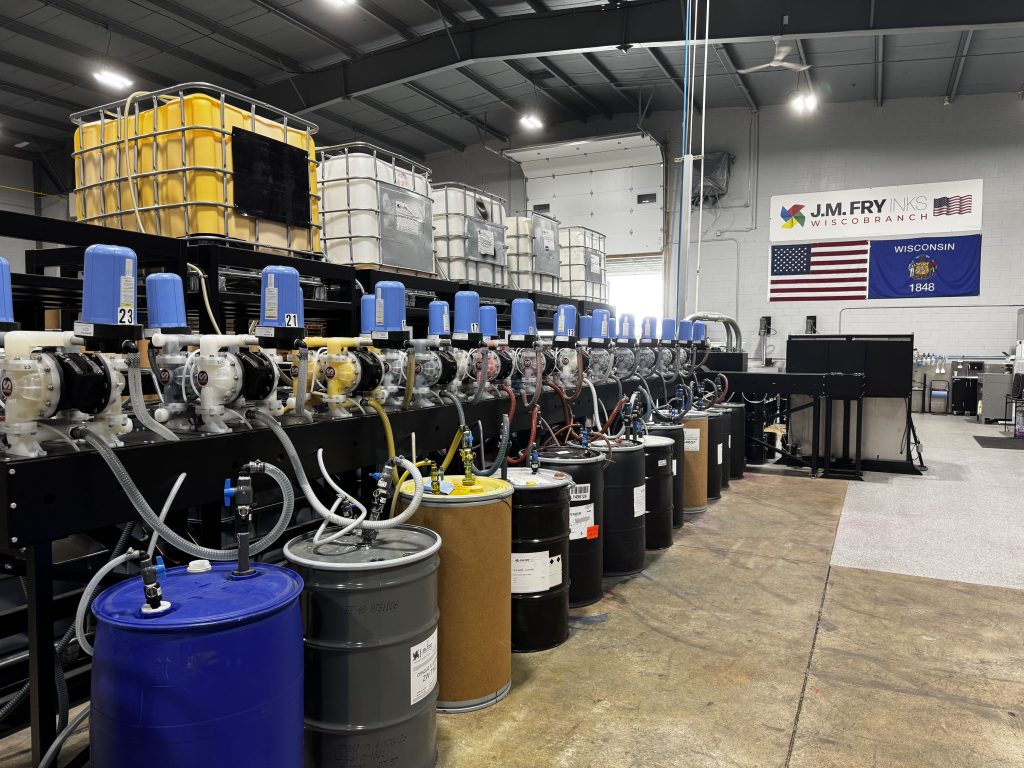
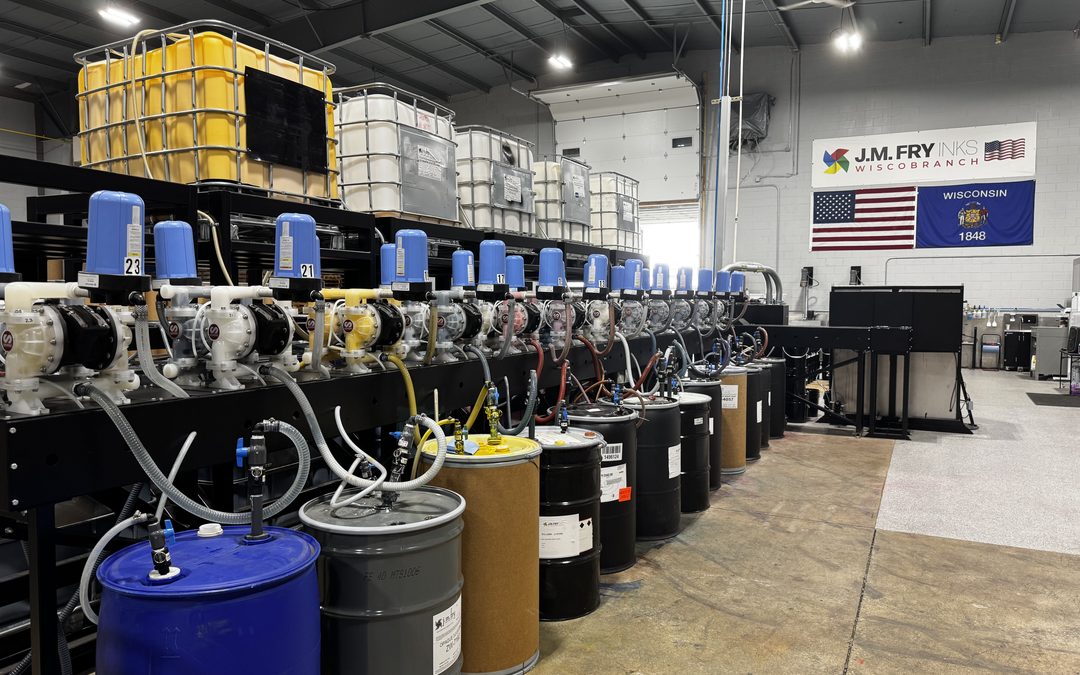
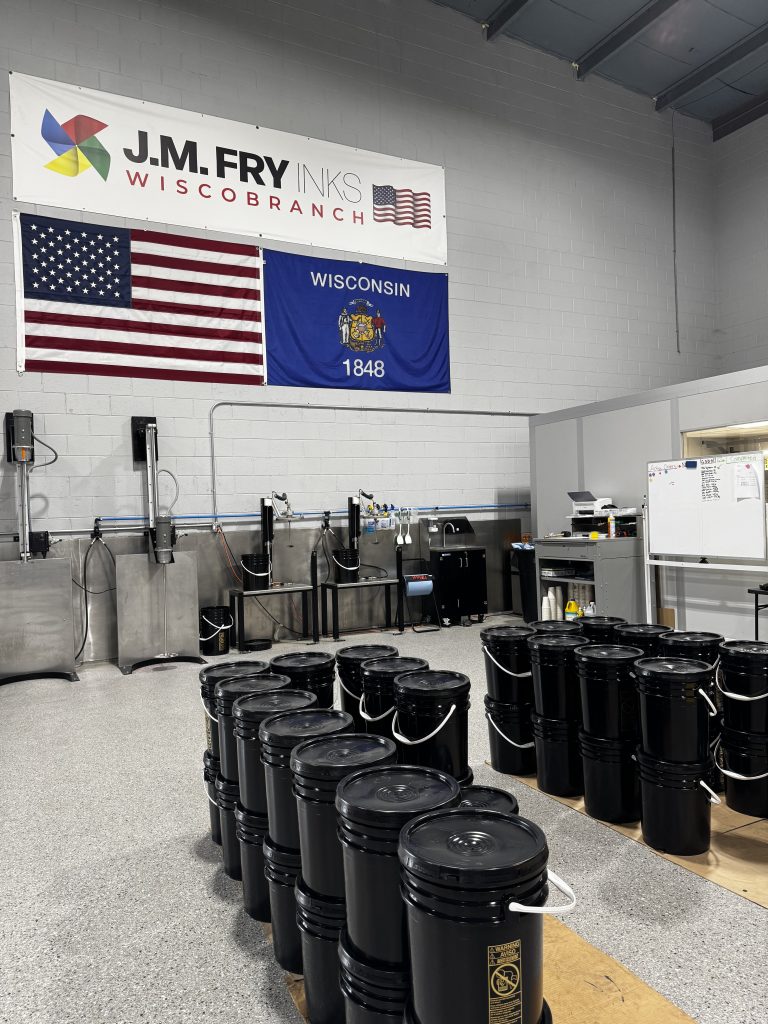
JM Fry recently opened a new location in Racine, Wisconsin, not far from the Illinois border.
For nearly nine decades, the Fry & Hodges family led JM Fry Printing Inks. In purchasing the almost 90-year-old company, Gaber and his partners set out to upgrade and expand the company.
“We aggressively set about investing in people, new buildings and the company’s infrastructure,” said Gaber. “We’ve been busily growing and investing and taking advantage of the contacts and relationships we have built up over our years in the industry.”
In their past shared work experience, Gaber and Mosley had worked together on six acquisitions. “We had been through this before and had a strong track record with those businesses,” Gaber said. “That gave us confidence in what we could do with Fry.”
A major priority for Gaber was to set up a location in Wisconsin to better serve customers in the area. “Fry had no prior footprint in the area; they were fulfilling orders from outside the region.”

Some of the core employees at the new Wisconsin location include, from left, Jake Wandrey, Operations Manager; Austin Zagar, Operations Specialist; and Solutions Engineer Reese Gaber.
To rectify the situation, Fry opened a state of the art location in Racine, Wisconsin, near the Illinois border.
“I grew up in the area and live in Stevens Point,” Gaber said. “I know many of the printers in the area from my past work life. Opening the facility was not in the original plans but once we saw the need, we moved fast. That’s one of the benefits of a smaller, independent company. We are much more agile and can move faster when decisions are made. Within 90 days of formulating the plan for the Wisconsin branch, we found the location, built our team and were open for business.”
An industry relationship with Tom Torosion, President of Torosion Tech Services, helped Gaber identify available warehouse space for the Wisconsin branch.
“Tom helped us find a practical solution to get established in Wisconsin, and we appreciate that,” Gaber said. “The location allowed us to move quickly, build our local team and bring ink production and technical support closer to our customers.”

Solutions Engineer Reese Gaber, like the other members of the Fry team, is trained across a wide platform of responsibilities and skills.
A key to the success of the new location was to make certain Gaber had the right team in place. Operations Manager Jake Wandrey and Solutions Engineer Reese Gaber lead the branch and JM Fry’s efforts across the region. Working alongside them are Operations Specialists Austin Zagar and Tay Lee-LeNair. The branch also draws on technical sales support from seasoned industry veterans John Meyer and Steve Fenters.
“Solutions Engineer is a good description of how all of them approach the job,” Gaber said. “They can match color, they can go to press, they can make ink, they can drive the forklift truck and run the scrubber, but they are also just as comfortable in the boardroom presenting to customers. They are all highly educated, highly motivated and solution minded”
When discussions first arose about purchasing JM Fry, it was quickly discovered that the ink manufacturer checked all the boxes the acquisition team had been looking for.
“There were several factors,” Gaber said about the acquisition. “Their size, reputation, and we specifically wanted to be in post-print corrugated. We like how the post-print corrugated market operates. We all enjoyed working with the AICC in the past, but we were anxious to do it with a leaner company that can handle larger companies while also catering to smaller-sized companies. Our customer mix is roughly 40 percent larger companies and 60 percent smaller companies. That kind of diversity is appealing to us.”
Gaber says the company’s size also helps it respond quickly to customer needs. “Big companies have some advantages, obviously, but they have many hurdles, as well. In past companies, we’d be thrilled to be able to turn something around for two-day delivery. Now we can aim for same-day or next-day delivery. We’re flat, we’re small, we move fast and we make decisions quickly.”
The buyers were impressed by JM Fry’s already established footprint, which at the time of purchase included East Brunswick, New Jersey; Atlanta, Georgia; Grand Prairie, Texas; Nashville, Tennessee; and its headquarters in Richmond, Virginia.
Since the acquisition, four branches have been added in Racine, Wisconsin; Kalamazoo, Michigan; Ontario, California; and Pine Bluff, Arkansas.
In time, the center of gravity for the company will shift as JM Fry plans to move its headquarters to Pine Bluff, Arkansas, where a project is already underway.
The company is converting a former 277,000-square-foot legacy facility, comprising four buildings, a water tower and a water treatment facility, into an operation designed to increase capacity and efficiency and provide room for future expansion.
“It’s a huge compound and we have a lot of work ahead of us,” said Gaber. “But the enthusiasm and excitement for the project are through the roof. We already make ink out of there, and we have a steady stream of equipment coming in.”
While JM Fry focuses on controlled sustainable growth in its newly opened operations, it’s also paid close attention to the ways in which it can improve and streamline its legacy branches.
“After the initial purchase I went to every facility and met with almost every single person,” Gaber said. “I shook their hands, I asked about their career and families. It struck me what an awesome responsibility it is, the opportunity to improve the lives of every employee who works with us. Because we are a true family business, it affects how we view people in the company and how they are treated. Our first priority after the acquisition was to improve people’s benefits and improve the infrastructure that supports everyone at each branch.”
JM Fry has worked to avoid silos and develop employees who can contribute across functions. Gaber stresses that the sales team for Fry are technical salespeople who can run a press trial, match color and help solve production problems, in addition to selling.
Everything points to a future whereby JM Fry continues to hone its expertise and work methods in a never-ending cycle of satisfying both its customers and its employees.
“We know how to be a big guy,” said Gaber, “and we know that’s not what we want. And we’re learning about what it’s like to be a little guy now, but we have aspirations and plans to keep growing. In the end, JM Fry will find its legs somewhere in the middle.”