
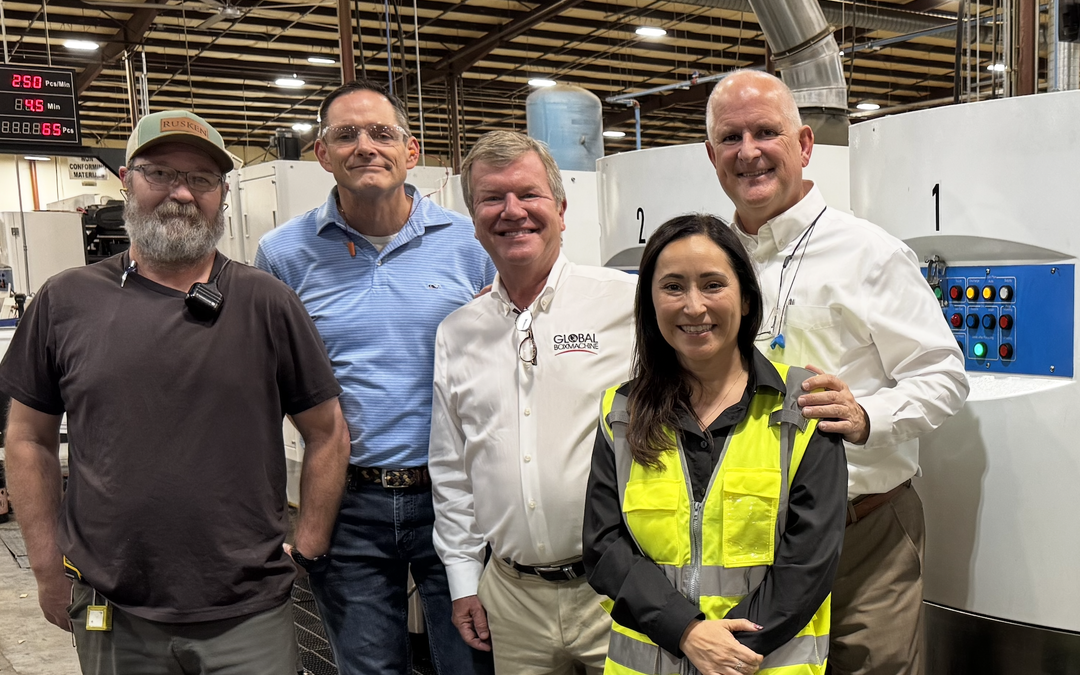
Twice this year, Global Boxmachine based in Gurnee, Illinois, has hosted Demo Week at Rusken Packaging’s facility in Cullman, Alabama, whereby visiting customers can view the array of machinery offered and installed by Global. During the recent event in mid-October, visitors watched live machine demonstrations, allowing them to compare equipment side by side, and received a firsthand look at the performance, capabilities, and technology behind each machine.
On hand representing Global were President Todd Crowell; Barry Hounshell, Vice President of Engineering; Melissa Carrasco and Todd Olson, both representing Sales.
“Rusken has been the perfect partner for us to use for these demonstrations,” Crowell said. “They’ve been a great customer for many years, are open about the ways they’ve used our technology to improve customer experiences.”
“It’s a good place for us to have these demo weeks,” said Carrasco, “because our customers can see the full line of equipment we’ve installed, including the first machine we installed in 2016 to see how it’s held up over the years. It’s a great, one-stop shop for people to come and see the equipment, talk to operators, talk to the owner, and get a chance to understand the equipment’s capabilities.
Guangdong Keshenglong (KL) based in Guangzhou, China and Shinko, a Japan-based company with manufacturing operations in China, is a partner of Global’s huge range of products for the corrugated market. The first KL machine that Global installed at Rusken was a K7 1628 Rotary Die cutter, which went into the Alabama facility 10 years ago. Their latest installation, the Shinko Velocity, is a fully servo-driven rotary die cutter built for high-speed precision and consistent print registration. Featuring vacuum transfer board handling and a servo-driven lead edge feeder, it is said to deliver stable sheet control and reliable performance at speeds up to 200 SPM. Velocity, according to Global, is engineered for converters who need accurate die cutting, fast setups, and dependable production throughout. Next, Global will install a ZH Quest Specialty Folder Gluer.
Rusken also has a 619 flexo folder gluer, the Shinko Super Alpha Mini, which is said to deliver high-speed performance up to 450 sheets per minute, precise folding accuracy, and ultra-fast setups in a compact flexo folder gluer. With fully servo-controlled operation, computerized setup in under two minutes, dual slotting, and tool-free print plate mounting, it keeps changeovers fast and production running efficiently. Its patented servo-driven design ensures consistent accuracy and reliable output at high speeds.
The company also has a 1227 Shinko Super Alpha flexo folder gluer, which is engineered for high-speed production, rapid changeovers, and consistent box quality. Featuring a fixed frame design, fully servo-driven operation including a lead edge feeder, and computerized setup in under two minutes, it allows operators to set up the next job while the machine is running—keeping downtime to a minimum, said Global. Running at speeds up to 450 sheets per minute and available in 619, 925, 1125, and 1227 sizes, the Super Alpha delivers the speed, stability, and efficiency converters need for modern production demands.
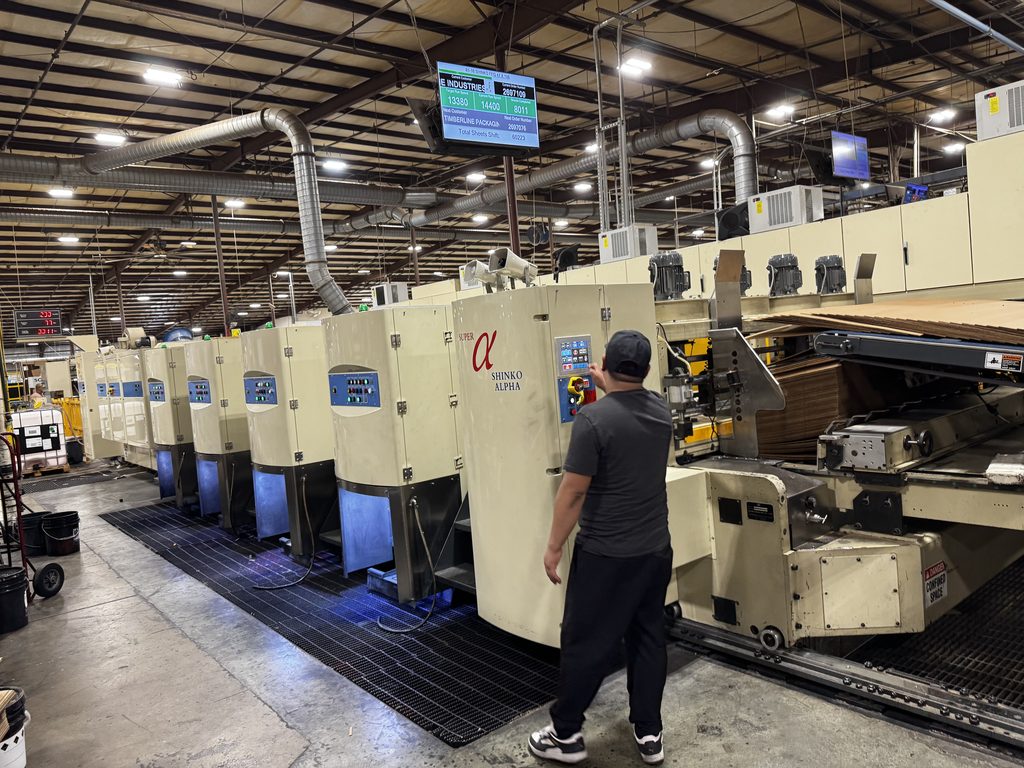
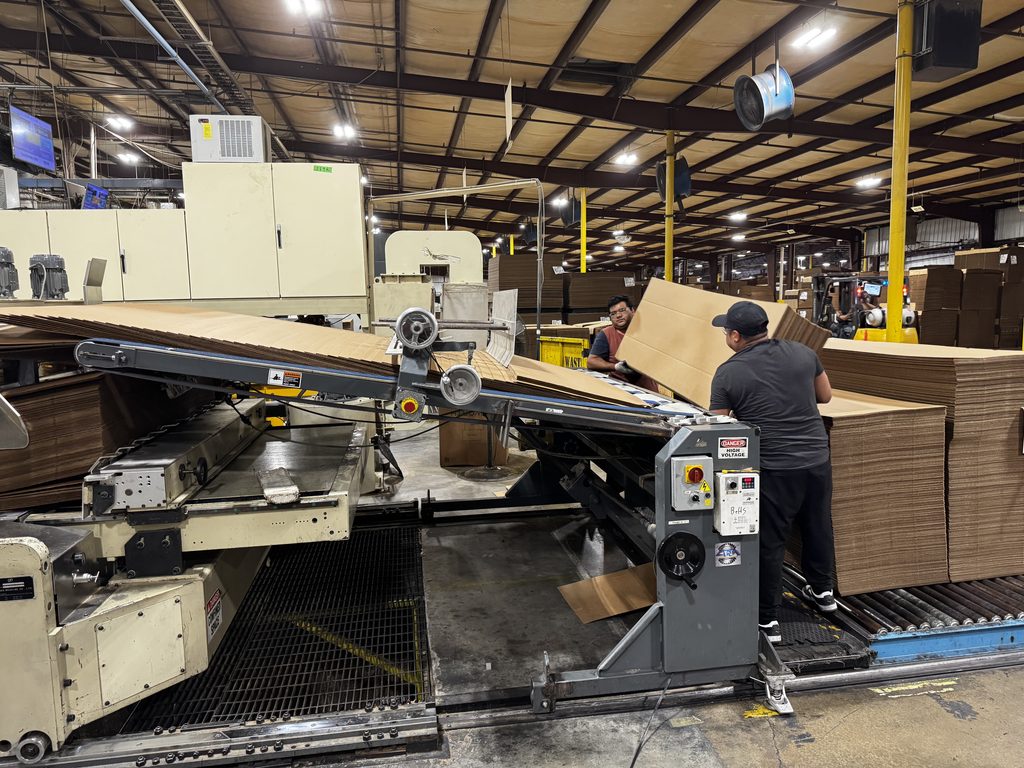
Global also installed a KL K1X 2253 jumbo folder gluer at Rusken, built for large-format, heavy-duty corrugated production. Designed to handle triple-wall board, it features full-width die cutting and optional stitching capability for demanding industrial and jumbo box applications. Running at speeds up to 4,800 sheets per hour and available in 2253, 2255, 2653, and 2655 sizes, the K1X delivers the strength, stability, and production capacity required for high-volume large-format converting.
Another of Rusken’s most recent Shinko installations is a 1645 Flexo Folder Gluer, which Crowell refers to as “an extra-large flexo folder gluer because of its 66 x 177 size. The range it offers converters is immense,” Crowell said. “It has a 66-inch rotary die-cut cylinder size, so you can take a die board off of a rotary die cutter, open the folding rails, and run a flat die cut through the machine as well.
The size range is from a minimum sheet size of 20.47 inch x 43.70 inch to a maximum sheet size of 67.71 inches x 177 inches. This offers a size range from a 50 inch FFG to a Jumbo FFG. So particularly for sheet plants, it can be a pretty unilateral machine or a utility player, if you will, particularly if you have the business in one of those segments where you’re running jumbo boxes and you can manage production flow from a 50 inch FFG and rotary diecutters. This gives a facility multiple configuration options within one machine footprint.”
“The Cullman plant is utilizing our equipment to power its market growth at an astounding pace,” said Crowell.
A Rich History
Global Boxmachine has a long and rich history in the corrugated industry. Beginning as a used equipment dealer in 1955, the company expanded to include new equipment, growing into one of the industry’s most recognized players.
“We are in an enviable position,” said Crowell, “from the standpoint of meeting customers’ need from the very beginning of the relationship. Because we offer both new and used equipment, we are part of the conversation with converters from the very beginning, especially if they are looking to trade out machines or sell old equipment to get new equipment.”
The company has reported strong sales in the past half year. Crowley sees a shift in the way integrateds view equipment purchases in the future. “Large integrateds have come to realize that they don’t necessarily need to buy the most expensive, flashiest flexo folder gluer, rotary die cutter out there on the market in order to be competitive. The Rusken plant will easily exceed more than 2 billion square feet in annual sales. So when you compare that to some of the larger integrated companies who feel they need to be with other higher-priced pieces of equipment in order to achieve that kind of reliability and throughput, it’s not true. We have really good machines that have proven the test of time. They set up in short times. They run the same speeds, and they’re much more efficient to operate. The total cost of ownership from purchase through the machine life cycle is considerably more economical.
“We’re not going to pretend to be everything for everybody,” he continued. “But if you want to run a mini flexo folder gluer at 450 kicks a minute, we can do that. You want to run a 1227 or a 50-inch flexo at 300 to 350 a minute, we can do that. You want set-up while run in under five minutes, we can do that. You want to run the new 1645, we did a trial with a customer last week, we’re running 354,000-square-feet an hour; 2.5 truckloads of bulk bin type boxes. So if that’s your business, you cannot do it better than that. And you’re spending significantly less.”
Standing Out In The Crowd
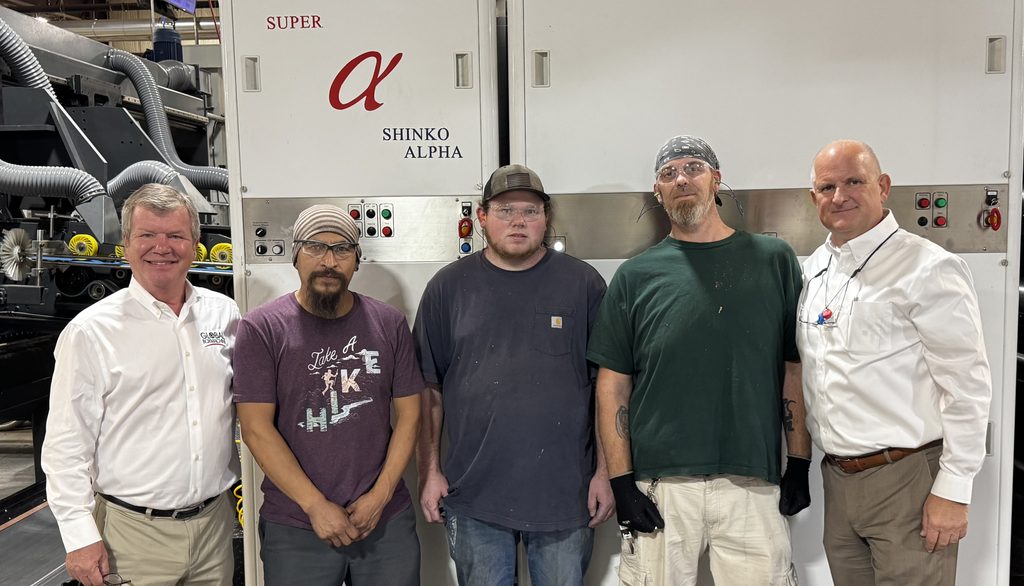
One of the factors Global feels is important in standing out in a competitive field is speed of delivery. The company sold a Super Alpha flexo folder gluer to a customer visiting the Rusken facility during demo week and expects the machine to be installed by the end of February 2027.
“When you talk about spending a certain amount of money on capital equipment, the longer you wait for delivery, the longer the ROI,” Crowell said. “If a customer has to wait 12 months to get a machine, they’ve already paid for the machine they bought from us before the other one could have ever hit the dock. That’s a pretty simple economic equation.”
Crowell, who spent 40 years as a boxmaker on the converting side of the business, fully appreciates the customer viewpoint during all of Global’s installations.
“It’s important to us that the machine performs the way it’s supposed to immediately. Oftentimes the customer isn’t expecting that. They imagine we are going to ramp things up slowly on the machine. But if we’ve promised a particular running speed, we want it running at that speed on day one. One of my pet peeves when I was on the box side of the business was to hear an operator tell me, ‘this machine never hit the parameters we were promised.’ That’s not going to happen with one of our installations. It will run to the specifications we promised before we leave the facility.”
Overcoming Labor Challenges
All manufacturing sectors are currently struggling with their workforces, including hiring, training and retention. Global has dealt with the ramifications of this trend as machine crews can change rapidly once the installation is complete. “We are often asked to return to a customer to perform more training because all the employees who did the original front-end training are no longer with the company,” Hounshell said.
“We’ve developed Preventive Maintenance Programs where our technicians come in once a quarter and take a deeper dive into the machine. We liken it to an oil change where a customer’s maintenance people are taking care of the machine every single day but once a quarter we can perform a full diagnostic. It allows the machine to perform at its highest speed, and allows customers to reach high Overall Equipment Effectiveness.”
Global has seen great demand for the Preventive Maintenance Program that allows customers to keep their machinery running at optimal level. Future problems can often be detected (and resolved) long before in-house maintenance people are even aware of them, avoiding possible breakdowns.
Global has seen firsthand how a properly trained crew running one of its machines can motivate that entire box plant to achieving greater heights. “If a machine sets a new performance standard, news spreads quickly through the plant,” said Crowell. “Suddenly, the crew on the neighboring machine feels they have to ratchet up their game. And that travels from one machine to the next, each crew trying not to fall behind the other. Or, even better, perform at an even higher level.”
Visit: boxmachine.com.