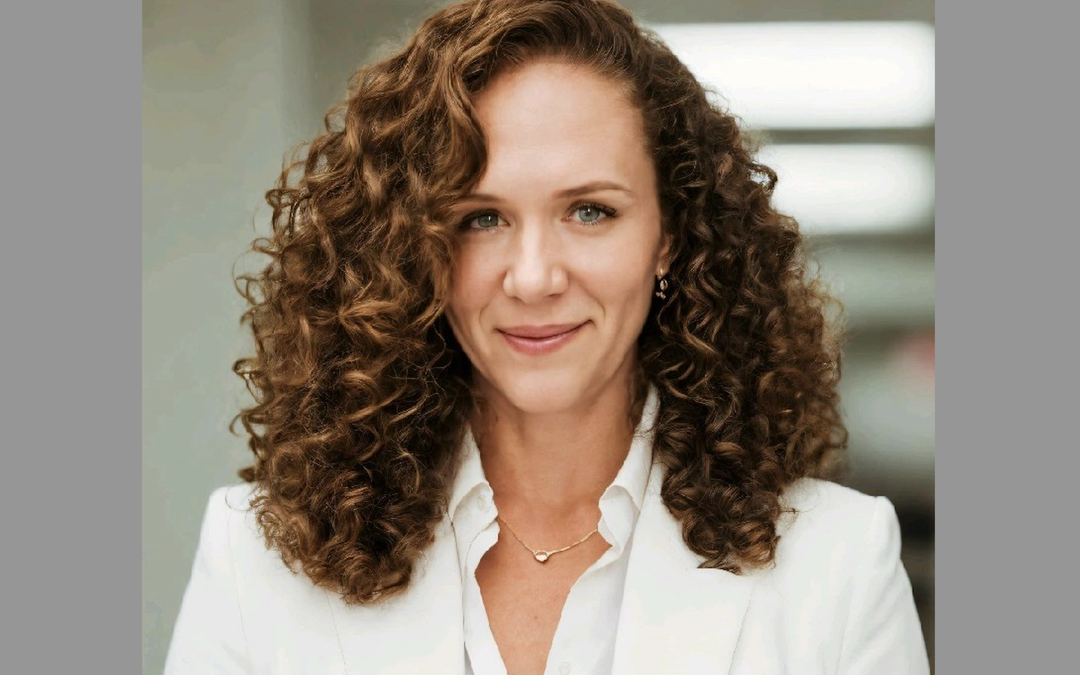
At the Women in Packaging Breakfast at Corrugated Week 2026, Simona Georgescu, founder and president of Adduco Communications, delivered a presentation about the power of reinvention.
For context, Simona shared a bit about her own origin story, to show the ‘meaning behind her madness,’ as she put it. She displayed an actual picture of the magazine clipping showing her parents and herself as a baby, a family of Armenian refugees who landed in the U.S. 44 years ago.
“I heard the story of the escape. I knew what it took for my mother, pregnant with me, to get out of Romania, to make it to Austria, where we got political asylum, to sit in a camp. Being the child of an immigrant family, there’s a certain expectation that when your family has struggled and fought to give you a better life, you’ve got to carry on and be better than they were.”
From Simona’s perspective, the story was one of resilience. That it was important to be strong, to keep going and persevere through everything.
Looking back now, she realized it was also about reinvention. “My mother was 30, my father was 42, and they were picking up their life and starting over,” Simona shared. “And they weren’t doing it necessarily out of fear, because the truth is, in 1982 Romania, the revolution wasn’t coming for another seven years.
“They saw it coming, though. They didn’t wait for it to happen. They saw that things were changing and took action. My mother said, I don’t think I want my kid to be raised here. We’re going to pick up and reinvent our lives at the ages that we’re at.
“And that became more of a story when I started my own business and began going through challenges. I realized that regardless of age or where you’re at in your career, sometimes you’ve got to look around and say, it’s time to start over and that’s okay.
For Simona, that meant letting go of a lot of false beliefs she had about herself and the business. She had to recognize where the holes were and then start documenting some processes to make things simpler and more streamlined.
In doing this evaluation of the business, she realized a theme: The things that helped us succeed to get us to this point are not the same things that are going to take us into the future.
An Internal Evaluation
Simona shared, “It comes down to three things: How we’re operating today, how we’re building teams, and understanding the ways that doing business has changed. It’s because things are changing at a rapid pace that we need to rethink our approach to moving forward. For those of us who have been around a while and have seen the changes over the years, we don’t need to wait because we can already see it coming.”
Simona invited the room to take that as motivation – a sign, if one were looking for it – to take action on the changes you know you need to make in your business.
She shared a hard truth she learned on her own journey: “Scale doesn’t fix ambiguity, it amplifies it. If you’ve got things that aren’t going right in the company, stay in that situation for long enough and eventually it’ll come back around to bite you. It just takes time.”
“Sometimes we know things are getting done simply because that person is good at the job and there’s a trust that it will get done. However, when that person leaves, we’re back to scratching our heads. At the end of the day, the organizational chart is not showing who’s doing the work and how. A lot of us wear sometimes three or four hats – which works until one person leaves and it takes four people to replace them.”
This struggle is also showing itself with the ‘silver tsunami’ – a generation of tenured employees entering retirement, taking with them a knowledge base built over years in the work. How do we retain that critical knowledge?
Changes In How We Lead
“It comes down to leadership. Once we understand who’s doing what and how our teams are really operating, we start to understand where the risk plays in. When I was working through these challenges in my business, I had to take responsibility. I had to realize at some point that the problem with my organization was me.”
As we navigate leadership today, it’s also important to recognize that people want different things from their careers. Not everybody is motivated by more money or chasing titles. But how many of us know what our colleagues truly value? How often are you taking the time to sit and think about, am I expressing gratitude for this employee in a way that lands for them?
“I think leadership is more than just putting the proverbial right person in the seat. It’s putting the right character, the right empathetic leader who leads with the intention of actually growing the folks under them.”
Simona also introduced the idea of fractional leadership as a response to the shift in leadership and team dynamics, especially post-COVID: “There’s a reason there’s 34,000 people out there with the title of fractional leadership. It’s because the way we do business has changed. And a lot of those leaders are making themselves more available in different capacities. Certain positions, like a CMO for example, aren’t needed for 40 hours per week. Sometimes an organization might only need 20 or 50 percent of a CMO’s time, making the fractional relationship beneficial for both parties. Ask yourself: how much support do you actually need?”
Utilizing AI While Building Trust
All of these shifting dynamics involve AI in some way. How we’re working is changing. Everybody is using ChatGPT or some other LLM to help complete repeatable administrative tasks, and now we’re talking about agentic AI. This technology has no doubt accelerated how we work, write, and produce. It’s deeper than that though.
“When you’re thinking about incorporating AI, the question becomes: Who’s going to do this job – a staff member or a robot? You’ve got to think about what you actually need and what seat you’re trying to fill. Because at the end of the day, AI tools make information gathering and organizing cheaper and faster. But the thing it doesn’t solve for judgment. In fact, it makes judgment more valuable.”
At this point, we’ve all used the chatbots, and we’ve all seen the end result of not scrutinizing the content it gives. The cost of doing this is damaged trust. Because there’s nothing worse than recognizing when somebody’s just blatantly used AI. Generally, the first thought someone might have is ‘Never mind. I’m not going to go back to that person for advice. They’re clearly not thinking for themselves.’
Right now, more than ever, is the time to build trust – with your buyers, yourselves, and your employees.
Questions And Takeaways
Simona wrapped the presentation with questions and takeaways for the audience to consider:
What processes in your business should be documented? Do you know anyone leaving whose job duties would be valuable to capture? Start with one role.
What capability do you need? If you’re struggling to motivate your teams or move things forward, ask yourself, who’s the right leader for this role and this team.
How are you building trust? I’d encourage you to dig a little deeper in your customer relationships because that’s where your value really is. That’s going to be your differentiator.
What are some repeatable tasks in your business today that could be automated with AI? Sometimes it’s as simple as having an AI assistant give you a morning summary of the emails waiting in your inbox that day; an easy, repeatable process that can be automated.
“It can be scary to do the necessary things to reinvent your business,” Simona concluded. “And it doesn’t mean that what you did didn’t work. It just means that it’s time to adapt. That’s what reinvention is.”