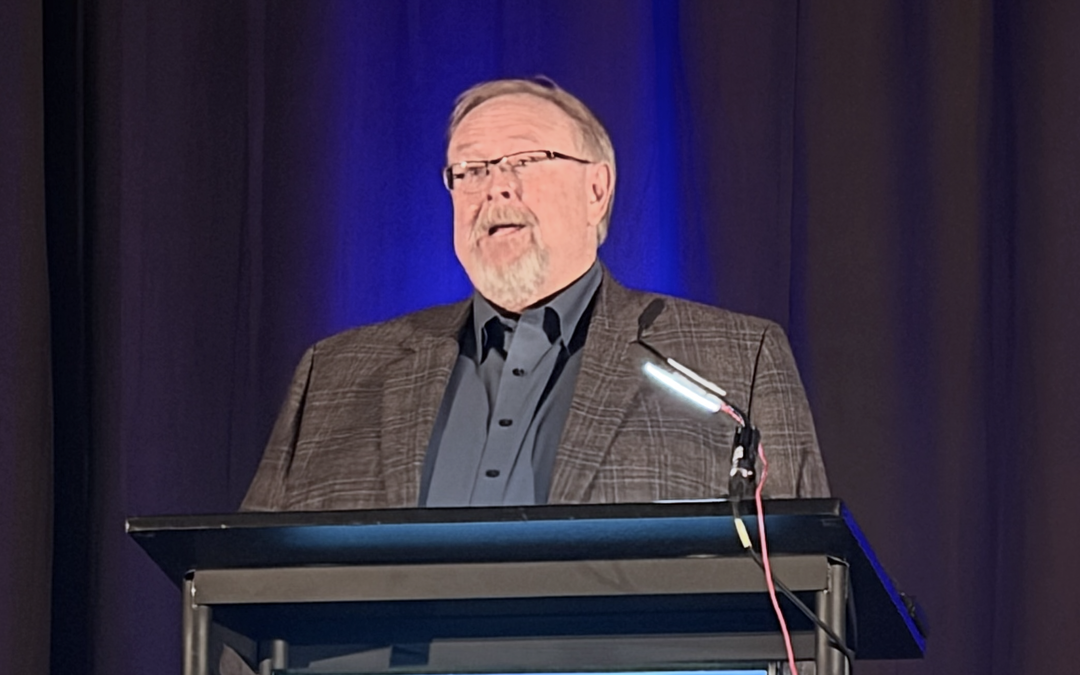
At Corrugated Week 2026 in Fort Worth, the AICC Chairman gavel was passed. Terri-Lynn Levesque of Royal Containers and Outgoing AICC Chairman, welcomed Mike Schaefer, President of Tavens Packaging and Display Solutions, as the new AICC Chairman. He delivered the following address upon acceptance of his new role:
When I was told I’d be standing up here as your incoming chair, my first instinct was to check whether someone had made a clerical error. Because I’m just a guy who used to fix cars for a living.
I grew up outside Denver, blue-collar house, dad a union sheet-metal worker. I loved hot rods — still do — and after high school I went to mechanic’s school instead of college. I fixed cars, then sold tools to guys who fixed cars, and neither one stuck. At 22, I needed a job. A buddy said the box plant down the street needed a sample cutter. I walked in. That was the last job I ever had outside this industry.
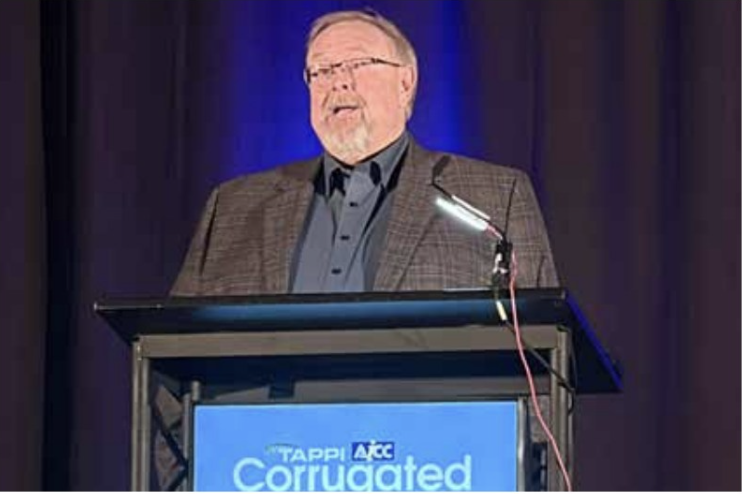
Mike Schaefer, President of Tavens Packaging and Display Solutions and new AICC Chairman, addresses the audience at Corrugated Week.
Tharco to Deline to Buckeye to Tavens — a sheet plant in Bedford Heights, Ohio, founded in 1957, where I’ve been for almost 15 years now. Prepress, design, sales, sales management, and now this. Not because I was the smartest guy in the room. Because at every stop, somebody took the time to teach me — one rung at a time.
That’s the whole idea behind this year’s theme: Raise the Bar, Train Your Frontline Leaders.
The Reason For The Theme
So let me tell you what keeps me up at night. Not consolidation. Not AI. It’s watching a generation of skilled boxmakers retire faster than we’re replacing the knowledge they carry.
Corrugated is a hands-on business. The best future leaders in this room aren’t sitting in a resume stack somewhere — they’re on your plant floor right now, solving problems nobody asked them to solve. And here’s what we usually do with that person: we make them a supervisor. Then we wonder why they struggle.
The best machine operator does not automatically become a good supervisor. We know that. But our habit, as an industry, is to promote on tenure and technical skill and expect the rest to sort itself out. It doesn’t.
I have a guy at my plant — talented boxmaker, we promoted him, and he struggled. I started to wonder if it had been a mistake. Then we did something obvious: we started teaching him to lead. Not manage. Lead. It started working.
Here’s what I learned. Leaders do three things. They know their team — really know them, not hallway-know them. They organize the work, because every development plan is different. And they define excellence, then keep moving the bar, because people win from winning.
My job this year, AICC’s job this year, is to help our industry build a real ladder. Not a title change. Not a different-colored lanyard. An actual path someone can see, believe in, and climb.
That ladder rests on three ideas.
Value One: See It Before It’s Obvious
Here’s a line I want you to sit with:
“Leadership isn’t a title. It’s a learned skill you have to teach and practice every day, at every level.”
If that’s true, then we are the teachers. Every owner and executive in this room is, first, a teacher — whether you signed up for that job or not.

Mike Schaefer
The first idea is seeing leadership potential before it announces itself. Your best future leaders won’t walk into your office and tell you they’re ready. They’ll be the one who quietly fixes a problem on second shift and tells you about it after the fact. Most supervisors can’t spot that yet — not because they’re bad people, but because nobody ever taught them what to look for.
So here’s my ask: who on your floor is already leading without the title? Some of you just thought of a name. Good — don’t let it stay in your head. And teach your supervisors to ask that question too. Spot problems first, yes. But spot people.
When you find that person, don’t wait for them to be fully ready. No one ever is. I wasn’t. The job is deciding early, signaling your confidence, and building the support around them. See it before it’s obvious.
Value Two: Teach To Lead
I want to tell you about Mike Reese. We call him the Tiny Viking — yes, he’s tiny, and yes, he looks like a Viking. Mike had been written off by more than a few supervisors. Good enough to show up, not considered a candidate for anything more.
Then we lost our lead operator on the three-color RDC, and we needed a replacement. We made Mike Reese the lead.
Here’s the part I want to be precise about, because it matters: we didn’t try him out. We didn’t give him a shot in that hedging way that tells everyone watching you’re not really sure. We committed first — publicly, in front of his peers. Because when you hedge on someone, they feel it, and so does the team around them. A provisional promotion is a vote of no-confidence dressed up as opportunity.
After we committed, we gave him direct supervision, coaching, training, and accountability — but only after we defined the standard. We organized the work of his development. And then we watched the goal posts move, because he kept hitting them.
That’s the second idea: teaching, not just assigning. And the hardest part of teaching on a production floor is that nobody thinks they have time for it. The machine’s running, the order’s late, the customer’s calling. I’ve lived it. But teaching isn’t a luxury. It’s the job. Every hard conversation you avoid today is a bigger problem tomorrow.
I’d rather have an uncomfortable conversation on a Tuesday than a crisis on a Friday.
We owe our people real transparency — not the comfortable silence that passes for politeness in too many plants. Telling the truth early, clearly and respectfully, is not the opposite of loyalty. It is loyalty. And when you build that with your front-line leaders, they start doing it with the people they supervise. That’s the multiplier — not a memo, not an all-hands meeting, but how a supervisor talks to an operator at six in the morning after something went wrong.
Teach to lead. Then watch your supervisors teach the people below them.
Value Three: Build A Tradesman, Not Just A Trade
This is the one I care about most. We have a labor problem in manufacturing, and I think we tell ourselves the wrong story about it. The line in a lot of boardrooms is that young workers don’t want to work hard, that they want things handed to them. I’m going to push back on that, hard.
The workers coming into our plants watched their parents get downsized. They watched institutions break promises. They’re not anti-work — they’re anti getting taken advantage of, and that’s not irrational. You can’t recruit your way past a trust deficit. Trust is built by front-line leaders who know their people, organize the work, and define excellence — which is exactly why leadership development isn’t an HR initiative. It’s a market strategy.
Here’s the other thing I want to say plainly: we need to stop saying “working in a box plant” and start calling it what it is. Boxmaking is a trade.
It’s skilled, it’s technical, it’s taught person-to-person like any craft worth learning. We’ve been selling that short for years.
The ladder only works if the rungs are visible. Young workers will not climb what they cannot see.
So say it out loud — production associate to operator, operator to shift lead, shift lead to supervisor, supervisor to superintendent. Put it in writing. Show them the whole staircase.
Stop trying to recruit believers. Start creating them, one supervisor relationship at a time.
The Bigger Picture
One more thing. The integrated producers aren’t the villain — they’re built for volume, and they run that lane well. Our lane is different: complex, custom problems that need craft, flexibility, and a person who knows how to say yes when the easy answer is no.

Terri-Lynn Levesque passes the gavel to Mike Schaefer.
I also want to say a word about technology, because it comes up every time I talk to owners about workforce development. AI and automation are coming into our plants. Some of that is already here. And I hear a lot of anxiety about what it means for workers.
Here’s my honest view: technology doesn’t replace the story I’m telling today. It creates more room for the parts of the work that actually need craft. The judgment calls. The complex jobs. The customer situations that require a skilled person and a real conversation. Technology will automate the repeatable. What’s left is exactly the kind of high-skill, high-touch work that talented, well-led boxmakers are uniquely positioned to do.

If we invest in our people now — in developing real tradesmen, in building real leaders — we will be in a better position to adapt to those changes, not a worse one.
The Charge
I want to close with something personal. I did not get here alone. People decided, more than once, to take time they didn’t have to teach me something I didn’t know how to do — before I’d earned it, before it was obvious I was worth the bet.
Every plant in this room has a future leader on shift right now who doesn’t know it yet. AICC’s job this year is to help you see them, develop them, and build the shared tools so your best supervisors can do — consistently, industry-wide — what your best supervisors already do instinctively.
We didn’t inherit a workforce that trusts easily. We inherited one that’s watching closely to see if we mean it. Every promotion from within is proof. Every hard conversation instead of an avoided one is proof. Every standard we hold is proof.
So here’s my charge — to you, and to myself:
Go find that person on your floor.
Then go build the ladder for them.